 EMBLLM
A summary of Adams et al., “Endovascular resuscitation: an expert practice review,” Emerg Med J 2026;43:626–633.
Endovascular resuscitation (EVR) is moving out of the cath lab and into the resus bay, and sometimes onto the roadside. Patients may already arrive with a device in place. This practice review from UK and US experts is a timely primer on three escalating techniques: REBOA, SAAP and ECPR. It’s built around two cases every EP will recognize: refractory VF arrest, and non-compressible torso haemorrhage when the OR is 30 minutes away.
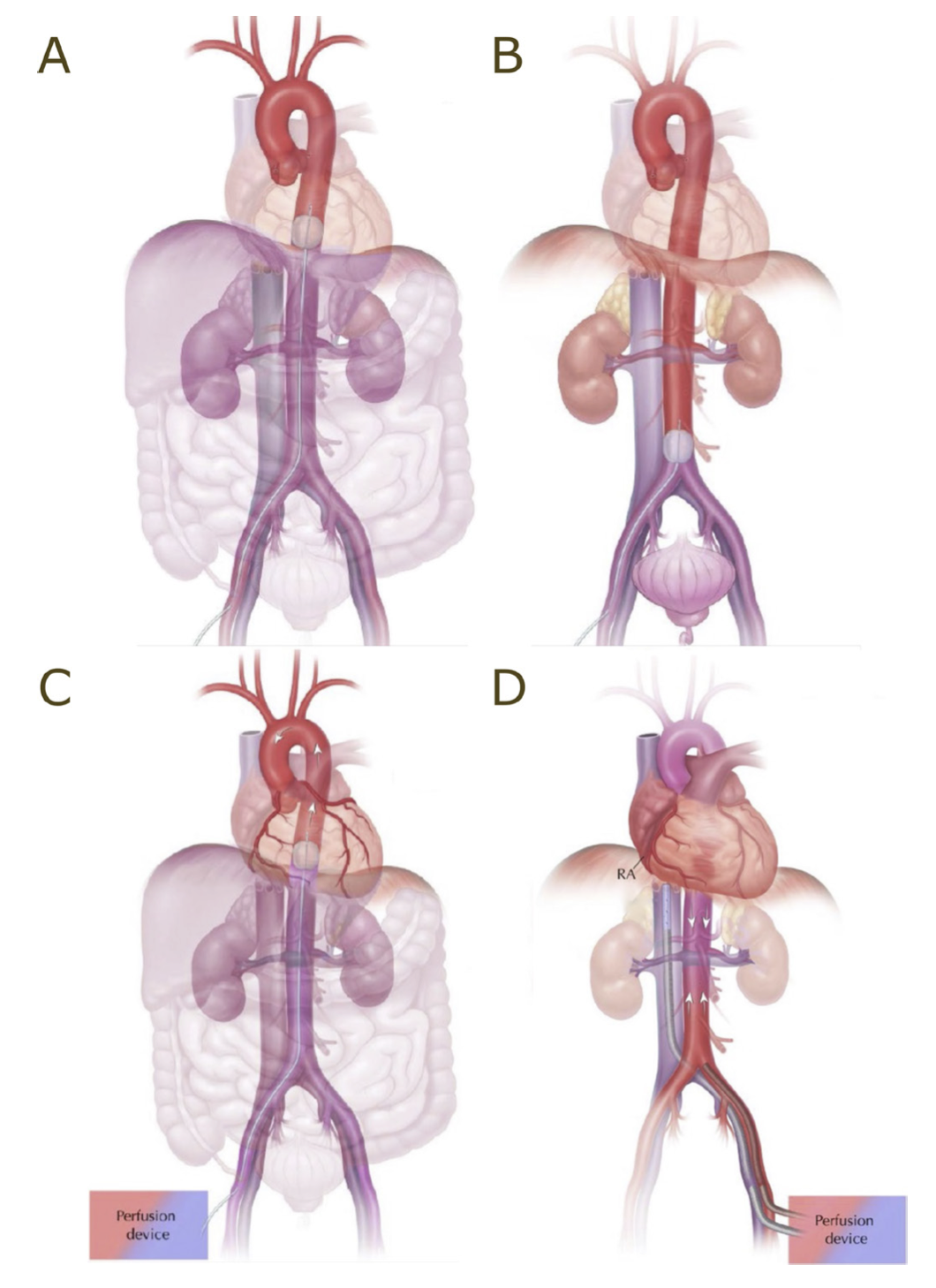
It starts with femoral access.
Every EVR technique begins with a common femoral arterial line. The authors call access the “Achilles heel” of EVR. Practical tips include ultrasound guidance, micropuncture kits (21g needle, 4–5 Fr sheath) and cutting a window in the pelvic binder. Placing an early 5 Fr arterial line in a crashing patient gives you invasive BP monitoring and keeps the door open to escalate.
REBOA: popular but unproven.
REBOA acts as a functional aortic cross-clamp. Zone 1 targets subdiaphragmatic bleeding, and Zone 3 targets pelvic or junctional bleeding.
- In the UK-REBOA RCT, 90-day mortality was 54% with REBOA vs 42% with standard care. There was an 86.9% posterior probability of harm, and the trial stopped early.
- There are caveats. Most centers were inexperienced with REBOA, only 19 of 46 patients actually got occlusion, and occlusion took a median of 32 minutes.
- US consensus limits Zone 1 occlusion to 15 minutes and requires definitive haemostasis to be close at hand. Suspected thoracic bleeding is an absolute contraindication.
- If a patient arrives with a balloon in place, watch the access site and the limb, and track total occlusion time.
SAAP: one to watch.
SAAP uses a Zone 1 balloon plus infusion of an oxygenated perfusate, which perfuses only the heart and brain. In pig models it beat REBOA convincingly (ROSC in 10/10 with whole blood vs 0/10 with REBOA). It is still experimental, and no device is approved for clinical use yet.
ECPR: the best evidence, but only in mature systems.
- In ARREST, survival was 43% vs 7%.
- In the Prague trial, the primary endpoint was not significant (31.5% vs 22%).
- In INCEPTION, a “real-world” trial, there was no difference (20% vs 16%). Median time to flow from ED arrival was 36 minutes.
- Pooled data suggest benefit, but outcomes depend heavily on time-to-flow and centre volume.
- ILCOR 2024 and ERC 2025 give a weak recommendation for ECPR in select adults. Typical criteria are a witnessed arrest, immediate CPR, a shockable rhythm and expected cannulation within 60 minutes.
- If your patient is on ECMO, check sats in the right arm to detect differential oxygenation.
The bottom line for EPs.
EVR is simple in concept but complex in execution. Before you reach for it, ask: is this the right patient, treated in time, by experienced operators, in a system built to support it? If you can’t answer yes to all four, the evidence says outcomes may be worse, not better.
New on EMBLLM: 15 fresh questions are out now. Test yourself on REBOA zones, ECPR selection criteria, trial data and more, and keep your resus knowledge as sharp as your femoral access. Head over to EMBLLM to try them today.