 EMBLLM
A summary of Alarfaj & Qedair, “Systemic Medications as Triggers of Acute Angle-Closure Glaucoma: A Narrative Review,” J Clin Med 2026;15:5834
Acute angle-closure glaucoma (AACG) is a can’t-miss diagnosis, and a recently started medication can be the trigger. This narrative review pulls together 43 key publications on drug-induced AACG. Its main lesson for the ED is that the drug’s mechanism changes how you treat the eye.
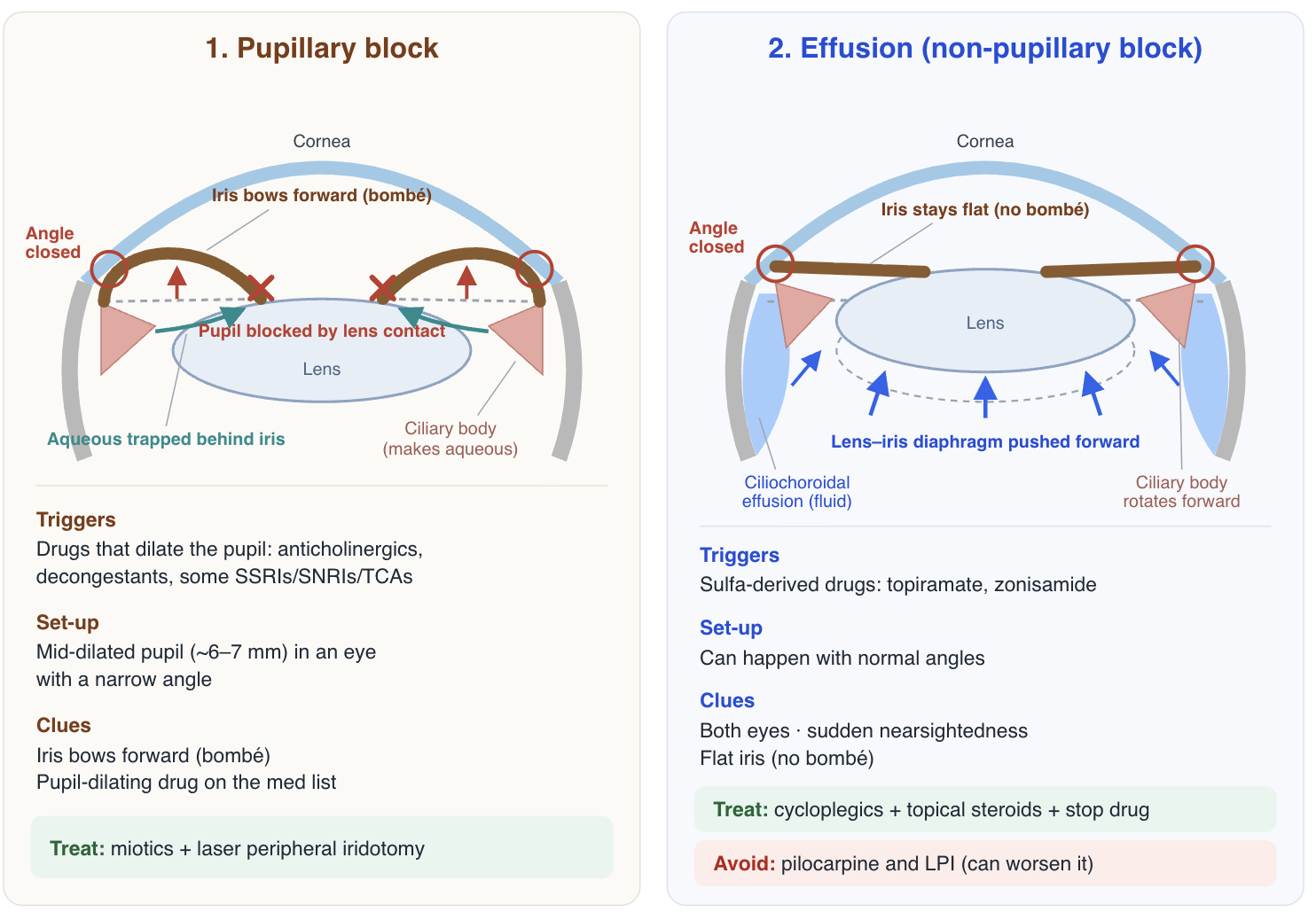
There are two mechanisms, and they’re treated differently
- Pupillary block is caused by drugs that dilate the pupil, such as anticholinergics, decongestants and some serotonergic agents. Risk is highest when the pupil is mid-dilated (about 6–7 mm) in an eye with a narrow angle. Lower intraocular pressure promptly and involve ophthalmology. Once pressure has fallen enough for a miotic to work, pilocarpine can help, and laser peripheral iridotomy (LPI) addresses the pupillary block.
- Effusion (non-pupillary block) is classically caused by sulfa-derived drugs, especially topiramate and zonisamide. Fluid around the ciliary body pushes the lens and iris forward. Look for both eyes affected, a sudden shift toward nearsightedness, and no forward bowing of the iris. It can happen in eyes with normal angles. Treat with cycloplegics, topical steroids and stopping the drug. Pilocarpine and LPI can make it worse.
- If you can’t tell which mechanism it is, the authors favor cycloplegia over miotics until imaging is available.
Usual suspects and the strength of the evidence
- Topiramate and zonisamide have the strongest evidence. AACG usually appears within about two weeks of starting the drug or raising the dose.
- SSRIs, SNRIs and TCAs are linked to AACG in population studies, with the most risk early in treatment and in older patients. Odds ratios include 5.8 for SSRIs and 4.04 for duloxetine.
- Sumatriptan had an OR of 12.6 in Korean claims data. Because migraine and AACG share headache and visual symptoms, a triptan-related case is easy to miss.
- Anticholinergics include oxybutynin, solifenacin, benztropine, scopolamine and first-generation antihistamines.
- Pseudoephedrine and phenylephrine carry the most risk in dim light.
- Alpha-blockers for BPH were linked to AACG with a hazard ratio of 1.52.
These are relative associations. The absolute risk is low and hasn’t been well measured.
ED pearls
- Ask directly about recent new drugs or dose increases, and about over-the-counter cold remedies and sleep aids. Patients often don’t mention these unless asked.
- The authors advise holding pilocarpine while IOP is markedly elevated (above about 40–50 mmHg).
- In rare cases, acetazolamide (also a sulfonamide) has itself caused effusion-type AACG. Avoid giving it again if you suspect that mechanism.
- A previous iridotomy lowers the risk of pupillary block but does not protect against effusion-type closure.
- Sudden blurred vision, halos, eye pain, headache or vomiting soon after starting one of these drugs warrants immediate assessment for acute angle closure.
The bottom line: Universal screening isn’t recommended. Recognizing the problem is what helps: think of the medication, identify the mechanism, and match the treatment to it.
New on EMBLLM: 10 fresh questions are out now. Test yourself on drug-induced angle closure, ophthalmic emergencies and more. Head over to EMBLLM to try them today.