 EMBLLM
A summary of Galluzzi & Garavello, “Treatment of Peritonsillar Abscess in Children: A Systematic Review,” J Clin Med 2024;13:7361
A teenager comes in with a “hot potato” voice, drooling, trismus and a uvula pushed to one side. Peritonsillar abscess (PTA) is the most common deep neck infection in children, but how should you treat it? This systematic review pooled 12 studies covering 2,211 children to see what clinicians actually do and how it works out.
Who gets it, and how it looks
- Mostly adolescents. Mean age across the studies ranged from 8.5 to 15.4 years, with no difference between boys and girls.
- Classic picture: sore throat, painful swallowing, muffled voice and neck pain. On exam, look for a one-sided bulge above the tonsil, uvula deviation, trismus and swollen neck nodes.
- Usual bugs: group A strep plus mixed flora, often including anaerobes.
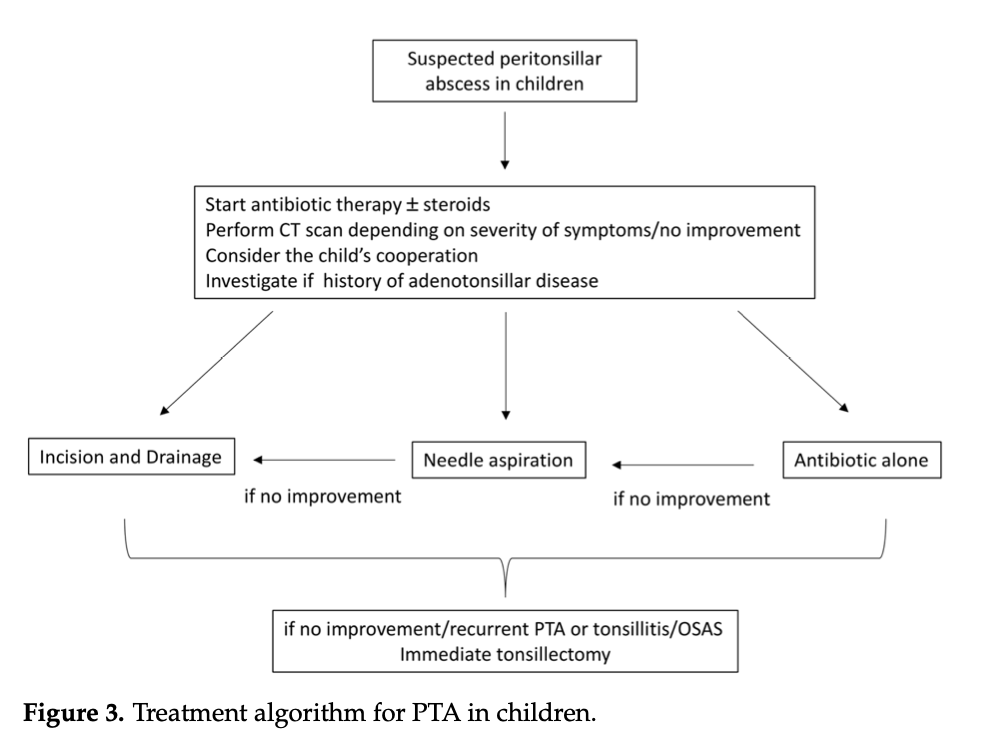
- Imaging: transcutaneous ultrasound can help tell abscess from cellulitis, which may spare some kids a procedure. Save CT for kids who won’t cooperate with an exam, or when you suspect spread into the deeper (parapharyngeal) neck space.
How kids were treated
| Treatment | Share of cases |
|---|---|
| Antibiotics + incision and drainage | 69% |
| Antibiotics alone | 16.4% |
| Needle aspiration | 7.6% |
| Immediate tonsillectomy | 7% |
What this means on shift
- Antibiotics plus incision and drainage is the standard of care. In older, cooperative kids, it can be done right in the ED. Younger or anxious kids may need the OR. In one study, up to half of children needed it.
- Procedural sedation helps. In one study, kids drained under conscious sedation had more pus removed and much lower pain scores than kids drained under local anesthetic alone (1.4 vs 4.2 out of 10). There was only one minor desaturation. You need staff trained in pediatric sedation, and be careful with sedation if the airway is threatened.
- Needle aspiration is a reasonable alternative. In one series, 87% of cases resolved with aspiration. Carotid injury is a potential complication. The review did not identify a reported case. Ultrasound guidance through the mouth can help you stay clear of the artery.
- Antibiotics alone can work in selected kids, especially younger ones with smaller abscesses and few previous episodes of tonsillitis. Watch them closely, because this group had longer hospital stays.
- Antibiotic choice: Choose empiric coverage for group A strep and oral anaerobes according to local guidance, then tailor it to the culture. No antibiotic regimen has been shown to beat another. Steroids are still controversial.
- Immediate tonsillectomy is uncommon. It’s mainly for kids whose drainage failed, who have recurrent abscesses or tonsillitis, or who have obstructive sleep apnea symptoms.
Red flags: airway compromise, spread into the deeper neck space, sepsis and torticollis. These kids need ENT immediately, and usually CT.
Recurrence and follow-up: abscesses came back in 2–15.8% of children, usually within 1–2 months. Older age and a history of recurrent tonsillitis raised the risk. Outpatient management did not lead to more recurrences than admission, so a well-drained, well-hydrated teen who can swallow can often go home.
The bottom line: drain the abscess and give antibiotics. Use sedation when it helps, consider antibiotics alone for small abscesses in young kids, and get ENT involved quickly if the airway or deep neck is at risk. Keep in mind that all of the evidence is retrospective, so these are pragmatic answers rather than settled ones.
New on EMBLLM: 10 fresh questions are out now! Test yourself on pediatric ENT emergencies, deep neck infections and more. Head over to EMBLLM and try them today.